We are delighted to announce that Pipal Tree has committed funding for a new urban forest in Kirtipur, in the Kathmandu Valley.
This exciting project follows a series of highly constructive discussions between our implementing partner, the social enterprise Lily’s Leaves, and the Mayor of Kirtipur, Mr Krishna Man Dangol, whose leadership and support have been outstanding.
The site is a 2,100m² roadside area that Lily’s Leaves will transform by planting around 6,000 native saplings, using the rapid-growth Miyawaki Method. Lily’s Leaves is the leading practitioner of this method in the valley, with an unrivalled track record. This Kirtipur forest will be the seventh urban forest Lily’s Leaves has planted since the launch of its urban nature programme in July 2023.
This ‘pocket forest’ is expected to grow up to ten times faster than a conventionally planted forest. The total cost will be £7.30 per square metre – significantly lower than the typical £10 per square metre – thanks to a substantial financial contribution from the Municipality towards site preparation.
Below are some images of the area that will soon be transformed:
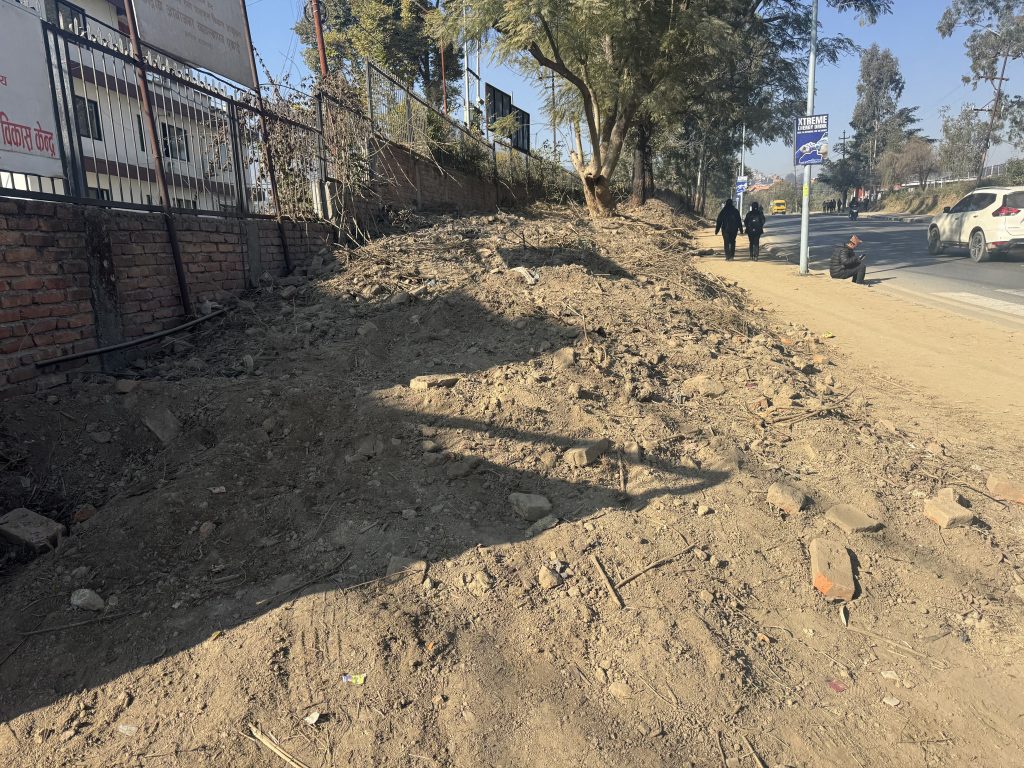
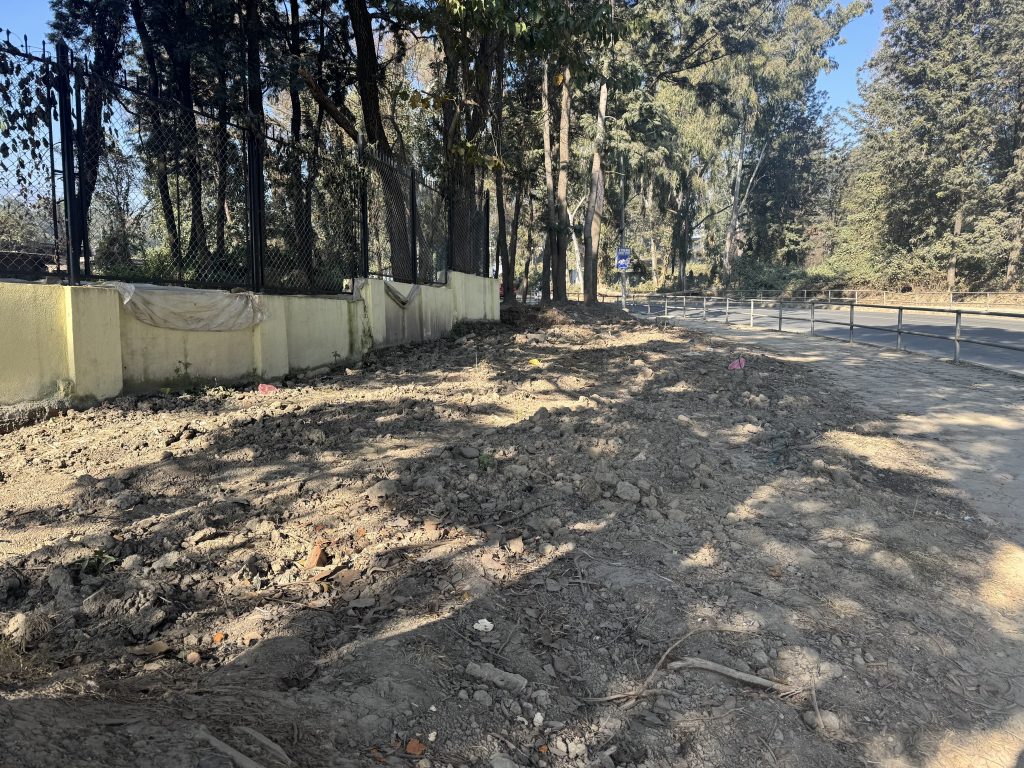
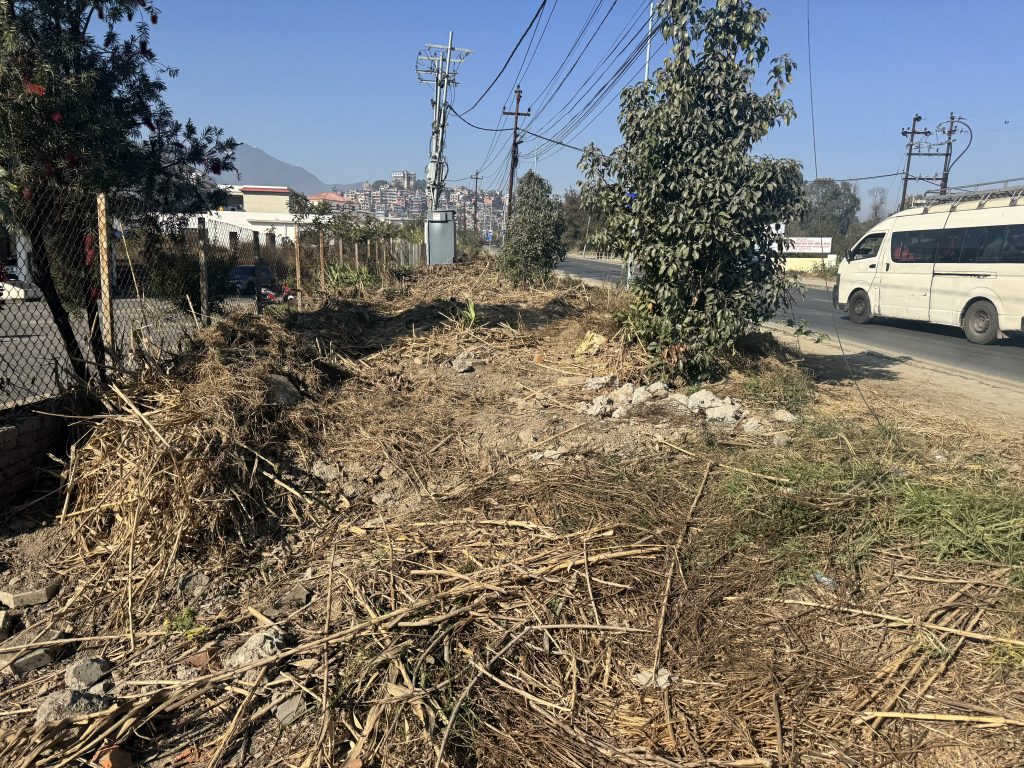
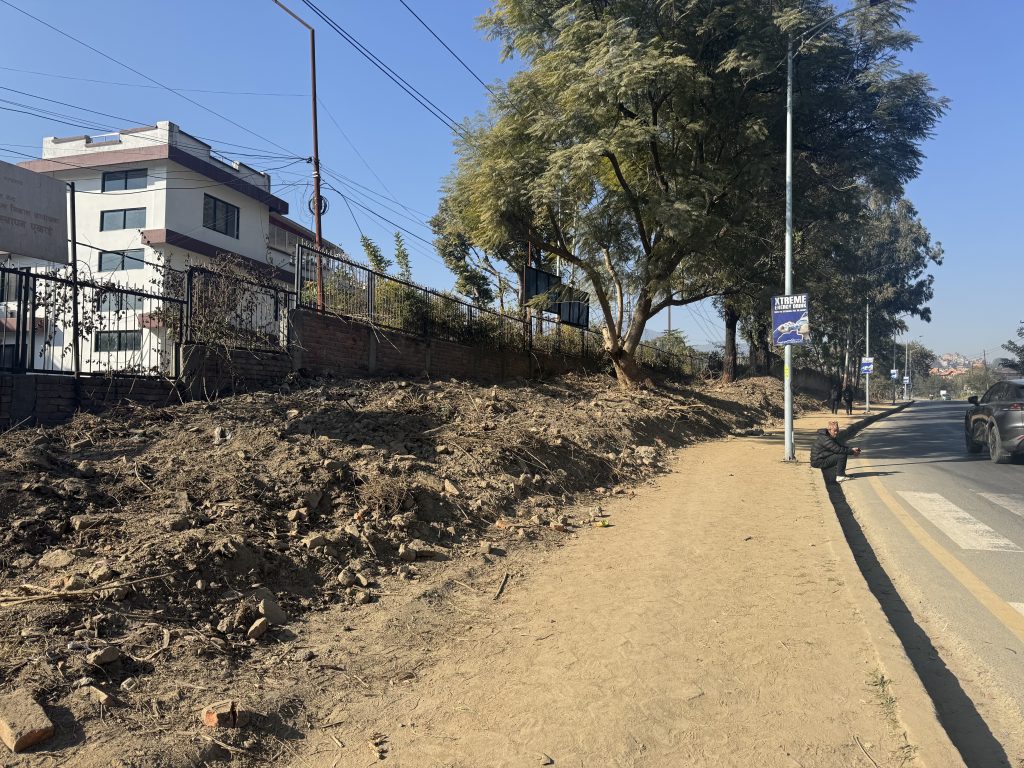
The images may not be immediately eye-catching, but this is in fact a textbook site for an urban pocket forest. Its location beside a busy road means the forest will absorb harmful toxins and traffic noise, provide much-needed local cooling for pedestrians, and restore biodiversity in a highly degraded environment. The site is also close to several schools and Tribhuvan University, creating valuable opportunities for engagement with students and young people interested in the natural world.
As the Google Earth view shows, there is significant potential for further reforestation across the wider area, where deteriorating air quality has become a major concern. The current Air Quality Index (AQI) in Kirtipur stands at 95, classed as ‘moderate’. A key measure within this is PM2.5—fine particulate matter measuring 2.5 micrometres or less in diameter. These microscopic particles are particularly dangerous because they can penetrate deep into the lungs and even enter the bloodstream, posing serious risks to human health. Today’s PM2.5 concentration is 6.6 times higher than the World Health Organization’s annual guideline level. As a result, residents are advised to keep windows closed, wear masks outdoors, use air purifiers, and limit physical exertion if they are vulnerable. As so often, it is the poorest households – without access to measures such as air purifiers – who are most exposed.
Air quality is worsening as climate change disrupts long-established weather patterns. Once-reliable seasonal rains, which previously helped cleanse the air, are increasingly failing. The highest AQI ever recorded in Kirtipur is 199. That’s over double today’s level.
Our ability to intervene in what is rightly described as a crisis, with health and lives at stake, has been made possible by a gift in the Will of the late Mr Jeremy Short, who passed away in September 2024. Once the forest is planted, a plaque will mark Jeremy’s generosity, but his true memorial will be a living, breathing forest that continues to protect people and nature for generations to come.