I arrived back in Kathmandu on Saturday, taking the long way round via Bangkok with Thai Airways, thereby avoiding both the current hostilities in the Gulf and the endemic passive aggression of Delhi Airport.
On Sunday morning, my inspirational colleague Lily Katuwal KC, Founder of Pipal Tree’s social enterprise partner Lily’s Leaves, took me on a whistle-stop tour of our joint urban reforestation projects before the afternoon monsoon deluge arrived. Rainfall has been heavier than usual this year and, as urban re-foresters, we’re certainly not complaining. Every site left me with a different impression and each had its own lesson to teach.
Lily has now established seven Miyawaki forests, with an eighth currently under way, alongside two native sapling nurseries. Fittingly, our first stop was the very first rapid-growth Miyawaki forest planted beside the Bishnumati River exactly three years ago.
It no longer lends itself to photography—unless you happen to have a drone. The forest has become so dense that it is almost impossible to see inside. Miyawaki forests grow around ten times faster than conventionally planted forests, but they also become up to thirty times denser. That density has proved equally attractive to an unexpected group of residents.
A pack of around 25 street dogs has made the forest their home, seemingly reverting from canine to lupine. They watched us silently from within the undergrowth, making it abundantly clear that this was now their territory. We wisely decided not to venture inside. Local residents now bring food for the dogs each day, and the forest provides them with night-time shelter and security.
Just six months after that first planting, Lily established a second Bishnumati forest. Although geographically close, it has developed a noticeably different character. The trees are younger and the planting is much more open. The difference reflects an important lesson from those early days. For, under pressure from the local authorities, more ornamental and exotic species were included in the planting. At that time, the concept of urban reforestation for biodiversity restoration was still unfamiliar. To many local people, a forest was expected to be attractive before it was expected to be ecologically valuable. Winning community support and securing permission to use public land meant compromising, at least initially. Looking back, those early decisions illustrate just how far attitudes have shifted in only a few years.
After a brief drive past our third Bishnumati plantation, we headed to what is undoubtedly the jewel in the crown of our urban programme: Swayambhu.
Walking along the broad paved path beneath the famous UNESCO World Heritage temple complex – also known as the Monkey Temple – it was immensely satisfying to see Lily’s Leaves forests flourishing on both sides of the route. The two plantations, established six months apart last year, have transformed what had previously been a degraded, rubbish-strewn, hillside.
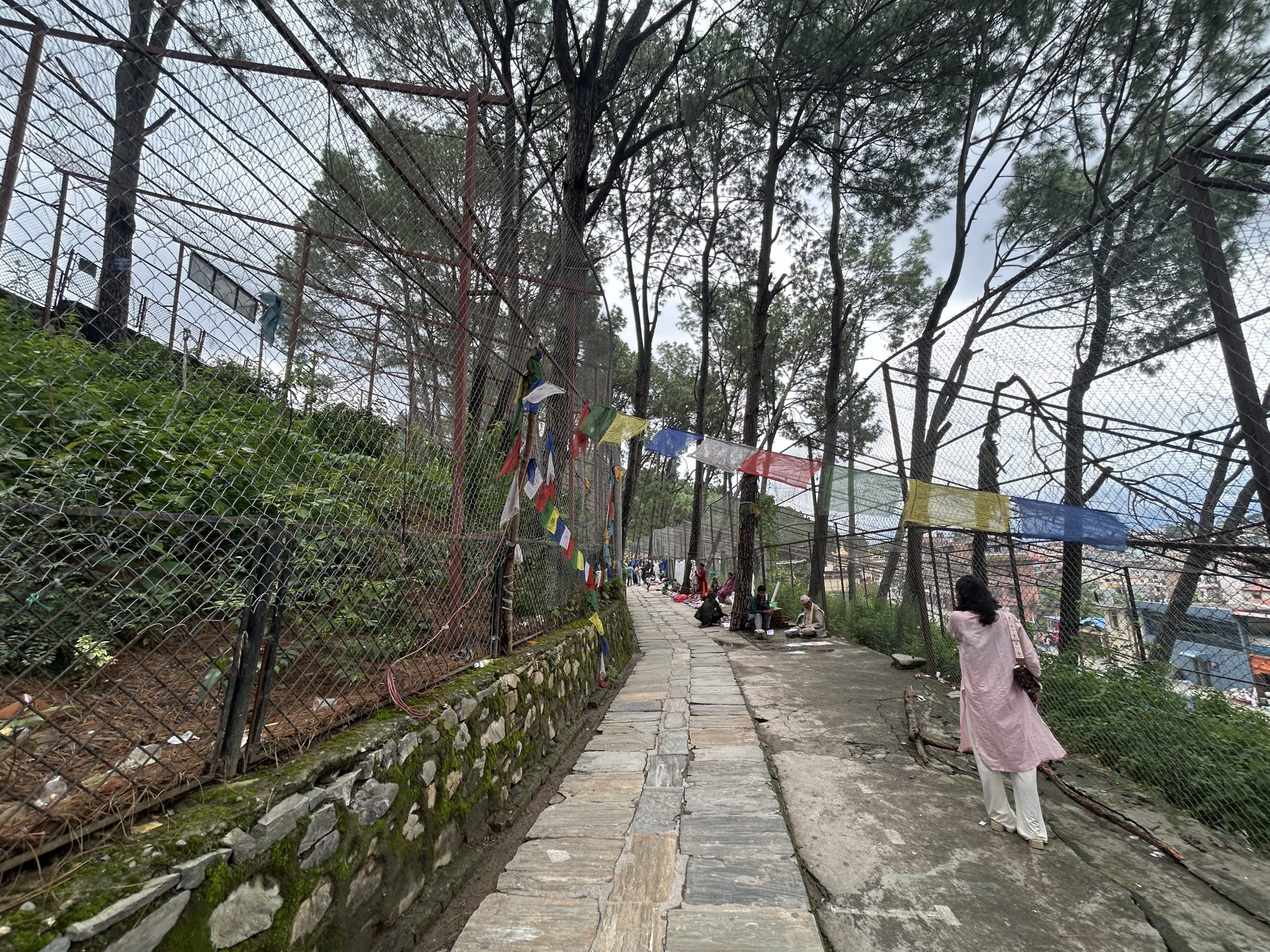
The project was exceptionally challenging. Preparing the steep slopes was difficult enough, but constructing extensive overhead fencing to exclude the resident rhesus macaques proved an even greater undertaking. The fencing has only been partially successful. Determined monkeys with remarkably dextrous fingers still find ways inside from time to time, meaning constant monitoring and regular repairs, with local residents often alerting us to new incursions. Ironically, removing weeds – which is essential if the saplings are to thrive – also makes the young trees far more visible and therefore more attractive to the monkeys. It is an ecological balancing act with no perfect solution. Lily told me that she would be delighted with a 60% survival rate in the lower plantation. But even that will be enough to create a magnificent native forest within another three years.
There has, however, been one delightful piece of serendipity. When work began on the upper plantation, we had hoped to obtain permission to remove the mature pine trees that were already growing there. They are not native to the area and their fallen needles gradually acidify the soil. Permission was refused, which at the time seemed disappointing. In hindsight, it may have been a blessing in disguise. For the carpet of pine needles has formed an excellent natural mulch, suppressing weed growth remarkably effectively, and the saplings in this plantation are much healthier that their counterparts in the lower plantation.
In a previous post I described the heart-break of discovering that monkeys had broken into our Swayambhu nursery, scattering seed trays and destroying hundreds of tiny seedlings. Our chief nurseryman, Laxmi, was reduced to tears by the devastation. It was therefore especially heartening to meet him again, now smiling as he watered the trees that will become Kathmandu’s forests of tomorrow.
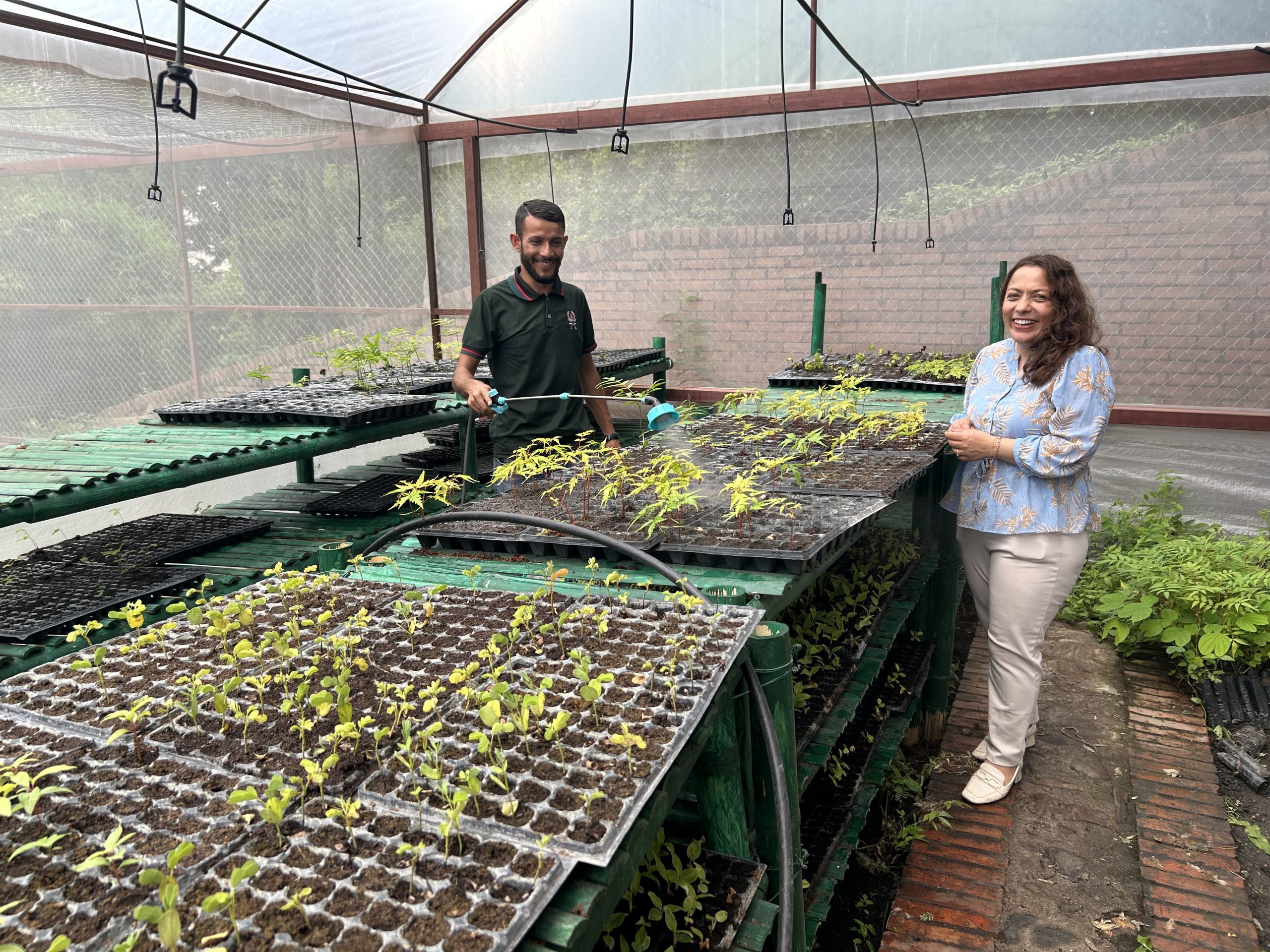
Laxmi previously ran his own commercial nursery and is an exceptionally knowledgeable arborist with an intimate understanding of Nepal’s native tree species. His expertise is invaluable, particularly as we collect seeds from natural forests on the margins of Kathmandu valley to ensure that our planting stock reflects local biodiversity rather than commercially available exotics.
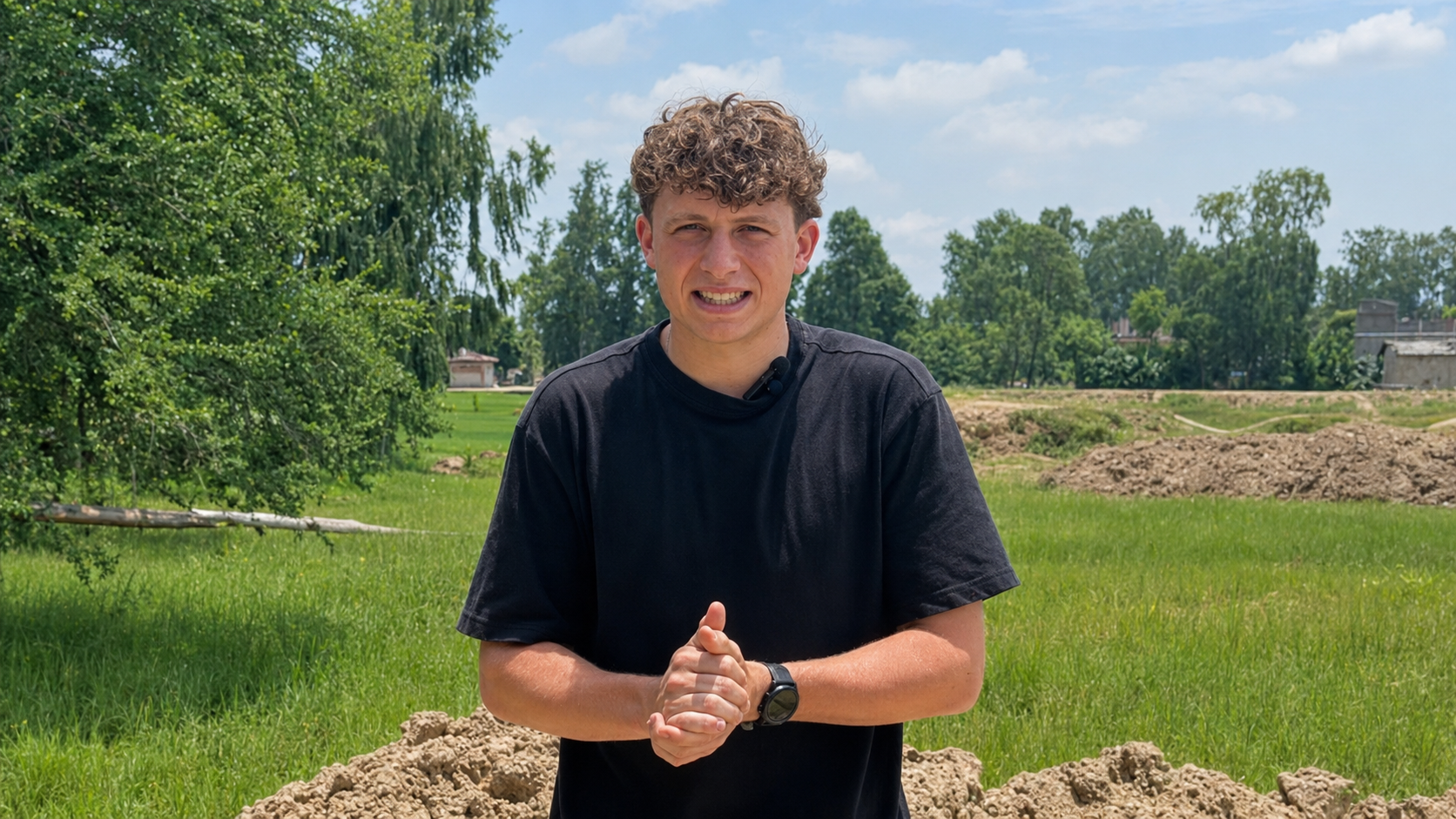
From Swayambhu we drove past the Kirtipur roadside plantation, which seems almost endless. Planted only in May, it is thriving and, perhaps mercifully, lies far enough from the Monkey Temple to avoid its troublesome residents. Our final stop was our newest plantation, which includes the future ‘Joe’s Forest‘ section (title picture). At just three months old, every sapling looked healthy and vigorous, undoubtedly benefiting from this year’s generous monsoon rains. Perhaps the most pleasing feature is the paved footpath that runs alongside the young forest. Lily told me it is already well used by local residents taking their morning and evening walks and before long that will be a lovely shaded walk.
For me, the Bagmati plantation site perfectly captures what our work is really about. These forests are not simply collections of trees. They are shared spaces where biodiversity, public health and community wellbeing meet. They demonstrate that people and nature do not have to compete – they can flourish together. That is the simple idea lies at the heart of Pipal Tree’s Mission:
Our Mission is to restore Nepal’s degraded environment so that wildlife and local communities can thrive together. At the same time, we aim to create healthier, safer lives for the poorest people and help them realise their full potential.