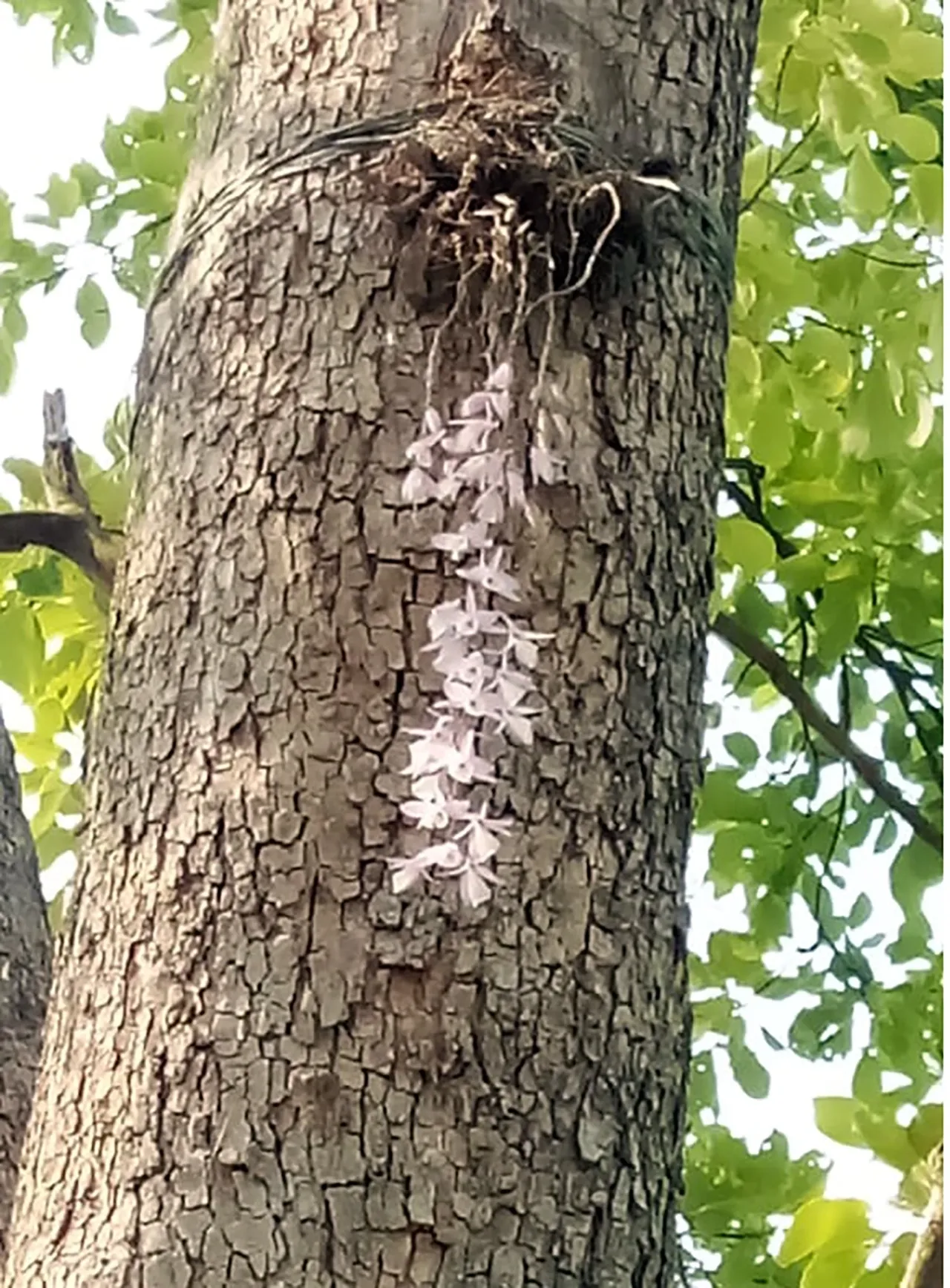
Among the many natural wonders of Nepal’s forests, few flowers capture the imagination quite like the Foxtail Orchid (Rhynchostylis retusa). Known locally as Sunakhari (सुनाखरी), this striking orchid bursts into bloom each spring, hanging in long, fragrant clusters that resemble the brush of a fox’s tail.
This orchid is an epiphyte – it grows on trees without drawing nutrients from them, relying instead on air and rain. Its dense, cascading spikes of pink-and-white flowers can stretch up to half a metre, each tiny blossom flecked with purple spots. In full bloom, a single tree can look as though it has been adorned with shimmering garlands.
The orchid is found n the mid-hills and Terai regions, often clinging to the sturdy branches of Sal and mango trees. Its flowering season from April to July is eagerly anticipated, marking the transition into the monsoon months.
But it is more than just a flower, for the Foxtail Orchid carries deep cultural significance. In rural Nepal, women sometimes wear the blooms in their hair during festivals and weddings. The flower is also offered in temples and is celebrated in folk songs and poetry as a symbol of love and natural grace. It also holds a place in traditional medicine. Healers used extracts of its roots and leaves to treat coughs, asthma, and wounds. Though such practices are less common today, they speak to the deep relationship between Nepal’s communities and their surrounding forests.
Sadly, like many orchids, the Foxtail Orchid faces threats from deforestation, habitat loss, and overcollection. Its beauty has made it a target for the ornamental plant trade. The species is now protected under Nepali law and listed in CITES Appendix II, meaning its international trade is tightly controlled. Conservationists are working with communities to promote cultivation instead of wild harvesting, ensuring that the flower can be enjoyed without harming natural populations.
For our part, our partner NGO, The Mithila Wildlife Trust, has been trying to reintroduce orchids to forests in Dhanusha District for the past seven years. Unfortunately this has been very unsuccessful, probably due to the rising temperatures. The only exception has been specimens of the Foxtail Orchid that our colleagues obtained from adjacent Siraha District. These have been growing in the Dhanushadham Protected Forest for the past two years and now seem to be spreading very well. In the coming time, we will extend their propagation to our new ‘Miyawaki’ forests, enhancing their biodiversity even more. And we’ll keep trying with the other orchid species!