
Last month, I paid a flying visit to Nepal with new Trustee Julian Bates, to introduce him to our projects. These include our Kamala River Basin project that he will be personally supervising in the coming time. We returned to the UK accompanied by Dev Narayan Mandal, Founder and Executive Chairman of our partner NGO, The Mithila Wildlife Trust (MWT). This would be his first visit to the UK and a vitally important one in developing his insight and building the capacity of MWT. Here are the headlines from these visits:
Nepal
The Urban Nature Project in Kathmandu
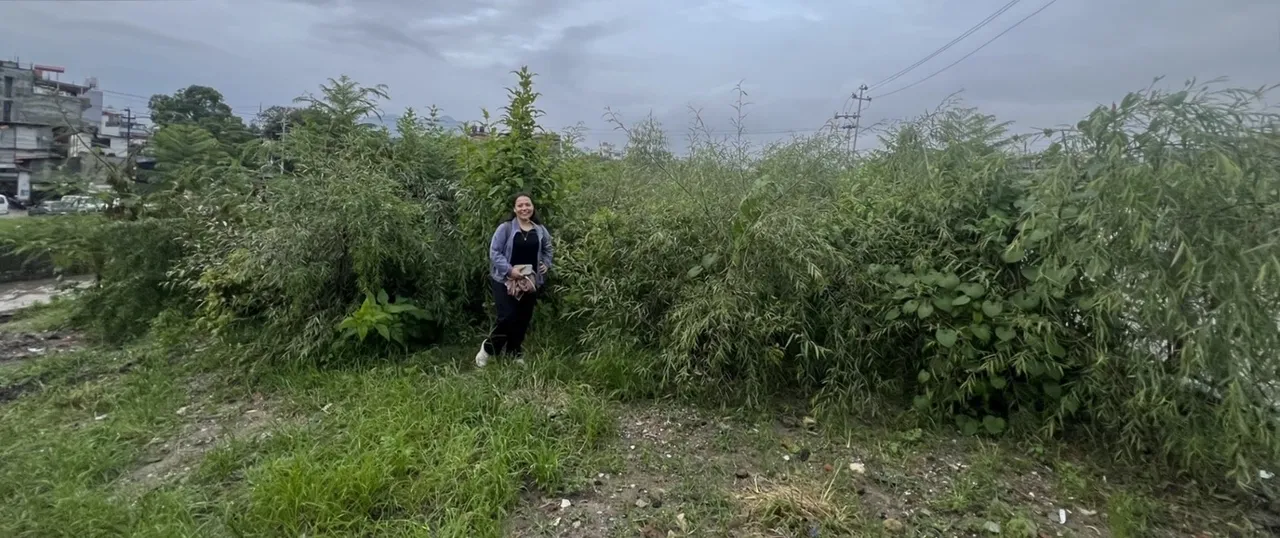
Lily with her first urban forest – one year old, planted on waste ground
I was impressed to see the progress made by our first urban forest in Kathmandu – planted by Lily’s Leaves just over a year ago in July 2023 alongside the banks of the Bishnumati River. It has actually become impenetrable and that is consistent with one of the claims of the Miyawaki rapid growth reforestation method – that forests grow thirty times denser than those planted conventionally. The vertical growth rate has even outstripped that of the first Miyawaki forests that we planted in the rural south and we attribute that to the amount of organic matter that was in the ground beforehand; this 1,500m2 site was once an unofficial public dumping ground.
Lily’s Leaves planted their second urban forest in June this year and the third is being planted at the time of writing. This is a small start, but there is definitely great potential to upscale this success in what is the world city with the worst air quality, while going some way towards pushing back against the stultifying concrete jungle of Kathmandu, cooling the atmosphere and making it a generally pleasanter and healthier place for its citizens. And, of course, an invaluable little oasis for urban wildlife.
We will continue to add urban forests as funds come available. Besides that, we are currently seeking grant funding to set up our own sapling nursery, to be managed by deaf women, that can provide saplings ‘free’ to our own plantations and generate income through sales. We will also extend this urban nature project to the city of Janakpur in south Nepal, to be managed there by MWT, so that our Urban Nature Project can mature into becoming a two-centre project.
Rural Nature Project – Dhanusha District, south Nepal
Meanwhile, in south Nepal our first rural nature project, that launched in December 2021, seems to be nearing an end point. It has taken us just two and a half years to create what looks very like an established forest, an achievement that usually requires 25 years.

December 2021: Exhausted community land, offering nothing to the community or to wildlife

The same spot in August 2024
The nice thing is that we have created a unique model in that we are now able to start removing the fences to allow some controlled access to the forested area by the poor people in the local community and, importantly, their livestock. Water Buffalo are now able to churn up the ground with their hooves and contribute dung, both of which enhance soil fertility and encourage bugs. This community access cannot become a free-for-all, so we have appointed a warden to monitor and control grazing so that the site is to the benefit of all living things – humans as well as wildlife. Therein lies the uniqueness of the outcome for it’s plain to see the equilibrium we have achieved, with no shortage of birds, insects and other wildlife in a habitat that includes dense forest clumps, pasture, wetland and a small river.

Villagers and their livestock, with the Miyawaki plantation in the background
As per the Urban Nature Project, we will roll out this model to other communities as funds come available. We will also be exploring how the infrastructure at this particular site can be adapted with signage, boardwalks and an information centre to make it more appealing for domestic and international tourists.
We are also investigating how we can improve livelihoods and the environment through regenerative farming, restoring the soil quality organically to the benefit of farmers and the environment. We are considering seedbank possibilities, towards reintroducing the use of more indigenous and resilient seeds in agriculture. Decades ago, the government encouraged farmers to use ‘better’ hybrid varieties, imported from India, but this has come at the price of a loss of resilience.
Bhatighadi Community School
Julian Bates has recently retired as a Partner in a leading real estate management company in London. So, I was proud to show him the success that we have enjoyed at Bhatighadi School such that this community school offers as good, if not better, facilities than any nearby private school. Our new two-storey classroom block is complete bar some finishing touches, complementing our earlier work in refurbishing other classrooms and the building of a computer room. The staff are very proud of their school and it was a delight to see the children all so keen and well dressed. Enrolment has increased significantly, including from two new village areas, and attendance has increased from approximately 70% to 90%.

The new classroom block – the buildings either side were refurbished

Julian visiting the computer suite

Inside one of the new classrooms - indistinguishable from a private school

The infants learning the alphabet
Our future support to this school can now be largely confined to continuing to fund an additional teacher, Jina Tamang, through our Christmas Big Give.
Sarlahi Community Learning Centre (CLC)
We were really pleased to visit a new Community Learning Centre (CLC) in Sarlahi that Lily’s Leaves built and set up in January/February using funds from the Christmas Big Give. This is now providing educational support to 150 children from the Dalit (‘untouchable’) community, giving them the best chance of completing their education at nearby mainstream schools. The enthusiasm of the students was very palpable, with one boy and one girl making little speeches of appreciation in their best English. This was unnecessary, of course, but deeply touching.

Left to Right - Dev Narayan Mandal, self, Raj Kumar Mahato (mayor), Julian Bates outside the new CLC

Keen students inside the CLC
During this trip we visited three other CLCs, constructed previously by us. One of these, at Dhanushadham, is currently having a second building constructed to manage demand that we had not anticipated.
We will continue to build CLCs, with a new building project to start imminently in the Kamala River basin area, funded by our summer Big Give appeal.
Livelihoods training in Sarlahi
Earlier this year, Lily’s Leaves launched tailoring training in Sarlahi District. This brought training (previously, conducted in Kathmandu out of necessity) closer to the point of need in south Nepal. We were able to visit the first course and gain feedback on the service we had provided.

Al fresco training is more agreeable during the monsoon season
Afterwards, we met with a young woman from the village who is a graduate of a previous Lily’s Leaves course in Kathmandu. She is now supporting herself and her family through local tailoring orders. The course tutor is also able to offer work to his graduates as he is unable to cope with local demand.
In the coming time we will extend our livelihoods training to include nature-based activities, in keeping with our core environmental interest. We will also offer microloans to women’s groups that will allow them to start their own enterprises (e.g. goat-keeping).
Bursaries for sixth form students
After visiting these young women, we met with two girls who, under a new scheme, will receive bursaries from us that will allow them, having passed GCSE equivalent, to complete college (A level equivalent). The girls come from very poor families, with one girl disabled in that she only has one eye (a birth defect). Sadly, a metric of success in Nepalese society remains getting married and this girl has no chance of finding a husband because of her disability. However, if we can fund her through the next two years of college, she has the potential to enter university and/or a profession and become a role model rather than a social outcast. These two girls along with 14 others (nine girls and seven boys) have been personally selected for bursaries by Dev, Founder of MWT, who has checked their academic potential and confirmed extreme family poverty. Bursary payments will be made directly to colleges, the first of these being this month.

The two bursary recipients outside their homes in Sarlahi District
Our immediate fundraising objective is to raise funds in the forthcoming Big Give Women and Girls appeal (10-17 October) that will allow us to expand this bursary programme and employ additional CLC tutors. The current fundraising target is £20,000, based upon a £10,000 matching pledge from The Big Give organisation itself. However, we are permitted to increase the matching pledge from our own network. It would be excellent if we could increase the matching pot to £30,000, giving us a £60,000 fundraising goal.
UK
The purpose of Dev’s visit was to see re-naturing and conservation projects, with a particular focus on how these are presented to the public for tourism and engagement (which is important for sustainability) and to meet with some donors. This represents an important aspect of our contribution to the overall working relationship – providing introductions, inspiration and capacity building of local people in Nepal to do a good job even better.
Our visits included:
- Two hours spent with National Trust warden Richard Snow, who gave us a personal tour of the Wembury site on the south Devon coast where his team is restoring forest on degraded farmland (which is exactly what we are doing in south Nepal) and improving public access.
- A trip to Wistman’s Wood on Dartmoor, one of the last remnants of temperate rainforest in the UK that is being expanded through a reforestation project.
- The Eden Project – a great example of how a desolate site can be turned into a tourism hotspot offering environmental engagement and, these days, education on climate change and biodiversity loss.
- The Natural History Museum – its recently launched Urban Nature Project is outstanding.
- The Zoological Society of London (ZSL) – an existing supporter of MWT, we had an opportunity to meet senior staff members who have been involved in The Darwin Initiative and its development of a wildlife corridor in south Nepal. Dev and I presented our work formally, including to remote attendees.
- The Knepp Estate – we joined an afternoon safari on this large estate that has been rewilded from being redundant farmland into becoming a colony for storks (for the first time in over 600 years in the UK) and endangered wildlife, including a growing population of nightingales. Not to mention how it is now a major tourist attraction.
- Sharpham Estate – where a former wine estate is being rewilded. After a tour of the site, Dev and I presented our work to 14 adult students who were attending an environmental course at the Estate.
- A meeting with Ocean Outdoor, a corporate donor which two years ago granted us a gift in kind of free advertising on digital display screens in major British cities. Two of their senior staff are due to visit our Nepal projects in October and there is potential for further support from Ocean Outdoor in our Christmas fundraising.

The atmospheric Wistman's Wood

Inspiration for Dev at The Eden Project in Cornwall
Fundraising
In spite of the challenges of the cost of living crisis, we have had enjoyed a highly successful year so far through our maximising the impact of supporter generosity by the strategic use of The Big Give. We have also been advancing our exploration of new funding opportunities in Europe and raising the profile of gifts in Wills. In respect of the latter, the week beginning 9thSeptember saw our participation in ‘Remember a Charity in your Will Week’.
As mentioned above, the next Big Give appeal will be in October before our Christmas Big Give campaign. The Christmas campaign will have a fundraising target of £350,000 spread across all of our Nepal programmes, ensuring that 2025 can start strongly and that our projects can continue to expand.



